Math activities for kids ages 5–7 can begin with actions they understand: adding, taking away, sharing and comparing. Objects make the story visible. A child can show what happened before they need to recognize a written number sentence.
Use blocks, toy animals and simple drawings to explore quantity and shape. Introduce symbols after the action is clear. This helps you see whether the child understands the relationship rather than only remembering a familiar answer.
- Counting words and counting objects
- Activity 1. Set a table for toys
- Activity 2. Split a number into parts
- Activity 3. Compare by pairing
- Activity 4. Run a pretend shop
- Activity 5. Build with shapes
- Move from objects to written symbols
- Plan a manageable session
- Use mistakes to choose better support
- Find math in ordinary routines
- Continue with IQClass
- FAQ: early math at home
- How high should a child count before starting school?
- Should we memorize addition facts first?
- Is counting on fingers acceptable?
- What if my child dislikes worksheets?
- When should we introduce zero?
- How can I check understanding of addition?
Counting words and counting objects
A child may recite numbers fluently but count one object twice or miss another. Invite them to move each block into a separate group as they count it. After the last number, ask how many there are altogether.
Arrange the same five blocks in a row and then a circle. Ask whether the number changed. Count again if needed. Later, combine different objects into one collection and discuss what makes them part of the set.
Activity 1. Set a table for toys
Put three toy guests around a pretend table. Ask for one plate per guest. Match each guest to a plate and check that nobody is missing one. Add another guest and discuss what changes.
Remove two guests and ask which plates are extra. The situation makes adding and taking away concrete. You can draw circles for the plates before introducing a written calculation.
Activity 2. Split a number into parts
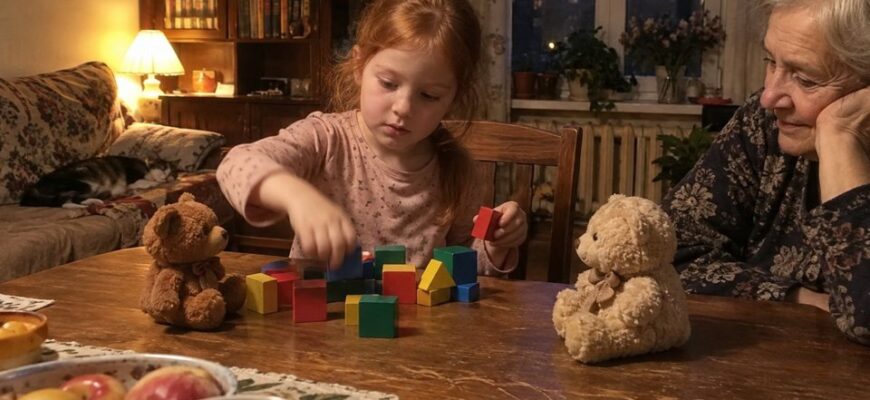
Take five large blocks and two containers. Invite your child to divide the blocks however they like: two in one container and three in the other, for example. Then try one and four.
Count the whole collection after each arrangement. The total remains five while its parts change. An empty container introduces zero in a meaningful situation. Avoid requiring every possible combination to be memorized in one session.
Activity 3. Compare by pairing
Make one row of four counters and another of five. Match them in pairs, one from each row. One counter remains without a partner, showing that this row has one more. Check the result by counting.
Now spread the shorter row out so it looks longer. Did the number change? This helps distinguish taking up more space from containing more objects. Let your child create a similar puzzle for you.
Activity 4. Run a pretend shop
Price a toy apple at two counters and a pencil at three. The child chooses an item and pays with the correct number. Ask how many counters are needed to buy both, then combine the groups to find five.
Use counters rather than introducing several currencies and complex change immediately. Later, give the child five counters and ask whether a four-counter item is affordable and how many remain. Encourage them to demonstrate the answer.
Activity 5. Build with shapes
Use a square and triangle for a house, rectangles and circles for a train. Discuss corners, curved edges and repeating shapes. Rotate a square and ask whether it has become a different shape.
Add a position task: place the circle above the square and the triangle to its left. The child follows the instruction using cards. This explores shape and space without requiring harder arithmetic.
Move from objects to written symbols
Once the child understands four blocks plus one more, write 4 + 1 = 5 beside the objects. Ask what each part of the writing represents. Then act out a taking-away situation and introduce subtraction.
If the signs become confusing, return to the action: did we add items or remove them? Writing many equations will not necessarily resolve that confusion. Separate handwriting practice from understanding the mathematical relationship.
Plan a manageable session
Begin with a small shop scenario, draw one purchase and invite your child to set the next price. Finish by asking them to explain your payment. The child has practiced a connected idea rather than several unrelated worksheets.
Start with quantities that are already comfortable. Increase the numbers or add a comparison, but not both at once. If the answer only appears after you count everything, offer more independent work at the earlier level.
Use mistakes to choose better support
For double-counting, move completed objects aside. For confusing length with quantity, make pairs. For a random answer, show the story with toys. Each adjustment addresses a specific difficulty instead of relying on “Be more careful.”
Avoid defining mathematical interest through constant correct answers. Asking a question, noticing a pattern and checking a result are also meaningful actions. Concrete materials can remain useful while written work develops.
Find math in ordinary routines
Count the cups needed for lunch, compare the number of socks in two groups or divide drawing pencils between two people. Keep the question genuine and small. A child does not need to turn every meal into a lesson.
When the answer is clear, ask for a way to check it. Matching cups to people or counting the combined groups gives a visible reason. Invite a child to invent a question for you so they also experience setting the condition.
Continue with IQClass
Browse the IQClass course catalog and select a math activity that fits the child's current understanding. Afterward, show a similar situation with blocks or a drawing. An adult can read the condition while the child makes the mathematical decision.
For patterns and classifications, explore logic games for ages 5–7. Counting, comparison and explaining can work together in a familiar playful situation.
FAQ: early math at home
How high should a child count before starting school?
Expectations vary by school and program. For home practice, focus on counting a manageable set meaningfully, comparing quantities and showing addition or removal. Ask the school about its specific expectations if needed.
Should we memorize addition facts first?
Explore small number combinations with objects and games before making memorization the whole task. A child benefits from understanding where an answer comes from and applying that relationship to a fresh situation.
Is counting on fingers acceptable?
Fingers can be a useful support for small quantities. Combine them with blocks, drawings and verbal explanations. Do not remove a working method merely because it looks simple.
What if my child dislikes worksheets?
Begin with a pretend shop, toys or building materials. Record one interesting result afterward. Writing something from the child's own game may feel more meaningful than a page of unfamiliar exercises.
When should we introduce zero?
Use a clear empty-set situation, such as a box with no blocks left. Show it beside a box containing items and name the quantities. The symbol then refers to something the child can see.
How can I check understanding of addition?
Offer a new story with familiar numbers and ask the child to model it. Combining the groups, explaining the result and checking it tells you more than repeating one memorized number sentence.