The solar system can feel enormous and abstract to a child. A list of planet names is easier to remember when each name connects to a question, a model or a picture. Start with a few basic distinctions and let activities give the words meaning.
This guide combines a small set of facts with practical learning games. Models help children explore relationships, but every model leaves something out. Saying what a model shows and what it cannot show is part of the activity, not an unnecessary complication.
- Begin with the Sun, Earth and Moon
- Make planet-order cards
- Build a model and label its limits
- Explore day and night with a light and ball
- Distinguish rotation from an orbit
- Create a planet passport
- Use a “what does this show?” gallery
- Connect space learning to everyday questions
- FAQ
- Should children memorize all planet names first?
- Is Pluto a planet?
- Must our model be to scale?
- Why use a ball for day and night?
- What if my child mixes up rotation and orbit?
- How do we continue after the first activities?
Begin with the Sun, Earth and Moon
The Sun is a star. Earth is a planet that orbits the Sun. The Moon is Earth's natural satellite. These three objects have different roles, even though all can appear in a child's picture of space.
The eight planets, in order outward from the Sun, are Mercury, Venus, Earth, Mars, Jupiter, Saturn, Uranus and Neptune. Pluto is classified as a dwarf planet. For reference pictures and basic information, use NASA's solar system overview.
Introduce these distinctions in conversation before asking for memorization. Ask the child which object represents the star in a model, which represents our planet and which travels around Earth. They can point or move objects while explaining.
Make planet-order cards
Create eight cards with a planet name and a clear picture or simple drawing. Lay them in order from the Sun. Read the names together and then remove one card. Ask the child to find the missing planet and explain where it belongs.
Next, shuffle three or four neighboring cards rather than the whole set. Reconstructing a short sequence is a manageable first challenge. Add the remaining cards when your child can use the sequence confidently.
Turn the cards into a checking game. Deliberately swap two after announcing that the order contains an error. Let the child compare the sequence with a reference and correct it. Using a source to check is a valuable strategy, not cheating.
Build a model and label its limits
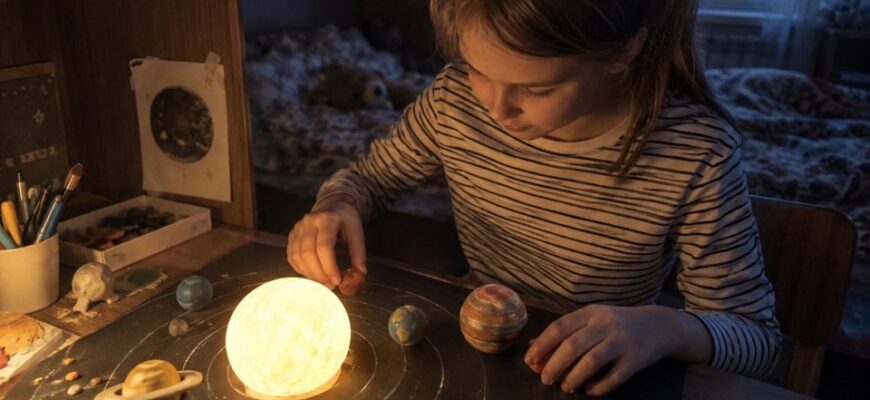
Use modeling clay, balls or paper circles to represent the Sun and planets. Choose distinct labels so the objects do not rely on color alone. Arrange them in orbital order on a clear surface.
Explain that a tabletop model usually does not show both sizes and distances accurately. A small gap between two clay planets is a convenience of the model, not their actual separation. Write “order model” on the display so its purpose stays visible.
Ask what the model helps you see. The child might say the order or the number of planets. Then ask what information is missing. This introduces the idea that a useful model can still be incomplete.
Explore day and night with a light and ball
Use a stable ordinary light to represent the Sun and a ball to represent Earth. Place a small removable marker on the ball as your pretend location. Keep the light fixed and turn the ball slowly.
Observe when the marker faces the light and when it turns away. The model shows how Earth's rotation relates to day and night. Keep the light away from flammable materials and use equipment as intended.
Let your child turn the ball and explain what is happening at the marker. If they move the light instead, pause and discuss which motion you intend to model. You can contrast rotation with traveling around another object in a separate demonstration.
Distinguish rotation from an orbit
Turn a ball in place to show rotation. Then move it around a central object to show an orbit. The two actions can happen together, but separating them first makes the vocabulary easier to understand.
Use your hand or a small object to demonstrate each movement without attempting a complete scale model. Ask your child to describe which movement they are showing. If they mix them up, return to the physical action before repeating definitions.
A year and a day refer to different motions of Earth. Introduce that connection after the child can distinguish the two movements. Avoid compressing all orbital details into the first session; one clear relationship is a useful starting point.
Create a planet passport
Choose one planet and make a page containing its name, its place in the order, a picture and one question. Find a small number of facts using an age-appropriate reliable resource and record where they came from.
Separate observed information from imaginative additions. A drawing of an imaginary visitor is a creative contribution; a statement about the planet's atmosphere should be checked. Both can appear in the notebook if labeled clearly.
Invite the child to compare the chosen planet with another using one feature from the source. Do not require a long list of numbers. A careful comparison and a new question can be more meaningful than copying a paragraph.
Use a “what does this show?” gallery
Arrange the order cards, clay model and day-and-night demonstration as three small stations. At each station, ask the child to explain what someone can learn there. Then ask what the display does not show accurately.
This activity changes the child from viewer to guide. They can label a station, demonstrate a movement or ask a visitor a question. If an explanation becomes unclear, improve the model together rather than demanding a memorized speech.
Take a photograph or keep one sketch so you can revisit the idea later. Ask what your child would add to a second version. A new label or clearer arrangement can show progress in understanding and communication.
Connect space learning to everyday questions
Look for the Moon from a suitable place with an adult and note when you observed it. Describe what you see without assuming the same view will appear at the same time every day. Use a current sky resource if you want to identify an unfamiliar bright object.
Never use these activities as instructions for looking directly at the Sun. For ordinary home learning, source images and the light-and-ball model provide useful alternatives. The IQClass solar system course can supply additional structured activities alongside your own models.
For more ways to follow a question, explore encouraging curiosity in children. Let the next topic come from something the child wants to understand, such as shadows, the Moon or the difference between a planet and a star.
FAQ
Should children memorize all planet names first?
They can learn names while using cards and models. Begin with the Sun, Earth and Moon, then build the sequence gradually. Understanding what the names refer to is more useful than reciting them without context.
Is Pluto a planet?
Pluto is classified as a dwarf planet. Explain the label simply and check a reliable source when exploring the classification in more detail. It is still an interesting part of solar-system learning.
Must our model be to scale?
No, provided you explain its purpose and limits. An order model can show the sequence while using convenient sizes and spacing. Do not present those convenient distances as realistic measurements.
Why use a ball for day and night?
Turning a marked ball beside a fixed light makes the relationship visible. The child can follow one location as it moves into and out of the illuminated side, then explain the model.
What if my child mixes up rotation and orbit?
Demonstrate each movement separately and let the child copy it. Use short descriptions tied to the action. Combine the movements only after the distinction becomes clear.
How do we continue after the first activities?
Choose one unanswered question and find a reliable resource or a small model that helps investigate it. A planet passport or observation notebook can preserve the question and what you discovered.