Multiplication for kids is easier to discuss when the symbols describe something a child can build. Four groups of three can become blocks, dots, toy shelves or a quick sketch. These models give children a way to recover an answer instead of depending entirely on a memorized list.
This home guide moves from equal groups to arrays, useful facts and short games. Start with a step your child can explain. School expectations provide context, but watching one attempt is often the clearest way to choose a manageable example. The goal is to connect the situation, the model and the calculation.
- Begin with equal groups
- Match the symbols to the story
- Build an array and turn it
- Use familiar facts as stepping stones
- Play three small multiplication games
- Respond to errors by comparing models
- A practical home sequence
- FAQ: teaching multiplication at home
- Should children memorize every fact first?
- What if my child still uses fingers?
- How can we introduce multiplication by zero?
- How can I check understanding without a test?
- Are timed fact games helpful?
- How do multiplication and division connect?
Begin with equal groups
Put out three plates with four large counters on each plate. Ask three separate questions: How many plates? How many counters on each? How many altogether? Three groups of four contain twelve counters. Write 4 + 4 + 4 = 12 and read it as three equal groups of four.
Now put an extra counter on one plate. Can the arrangement still be described as three identical groups? No, because one group has a different size. This small change makes an important condition visible. Let your child compare the two arrangements before introducing more notation or asking for a quick answer.
Match the symbols to the story
Use the reading convention taught at your child's school, and explain what each factor represents. Saying “four groups of three” alongside an array prevents the numbers from becoming disconnected labels. Different classrooms may describe the factors in a different order, so keep the language consistent with the child's learning materials.
Try this story: four shelves hold three toy cars each. There are twelve cars altogether. Draw the shelves separately and ask your child to show where each number appears. Then invite a new story with the same total. Check both the total and whether the model matches the particular grouping in the story.
Build an array and turn it
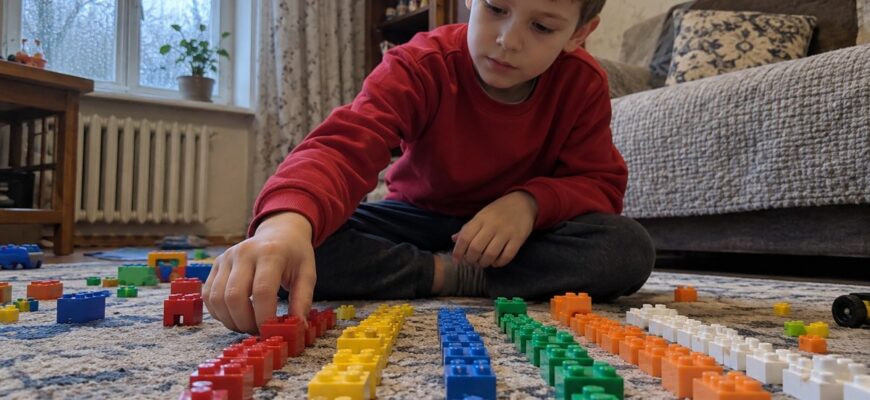
Arrange four rows of three blocks. Count the blocks individually, then count by threes. Turn the paper or view the arrangement from another side: now there are three rows of four. The total remains twelve because no blocks were added or removed. This makes 4 × 3 = 3 × 4 something a child can inspect.
There is no need to begin with a formal definition of the commutative property. Ask, “What changed, and what stayed the same?” Keep the distinction between stories and totals: four boxes containing three objects tell a different grouping story from three boxes containing four, even though both contain twelve objects altogether.
Use familiar facts as stepping stones
Useful starting points include multiplying by two, five and ten, when your child can already count in those steps. Two equal groups connect to doubling. Groups of five connect to a count of 5, 10, 15 and 20. Discuss tens through place value rather than presenting a written shortcut without meaning.
Build a less familiar fact from a known one. If 5 × 6 = 30, adding one more group of six gives 6 × 6 = 36. If 10 × 7 = 70, taking away one group of seven gives 9 × 7 = 63. Show the extra or missing group in a drawing and ask your child to explain the change.
Play three small multiplication games
In “Pack Shop,” each pretend packet contains four stickers. How many stickers are in two, three and five packets? The answers are eight, twelve and twenty. Change the packet size after a few rounds. Keep the storyline simple so you can tell whether a difficulty concerns multiplication, reading or remembering too many details.
For “Hidden Array,” draw five rows of four dots and cover two rows. Ask how many dots are visible and how many are hidden. Twelve are visible, eight are hidden and twenty are in the full array. Check with 12 + 8 = 20, then uncover the paper so your child can test the explanation.
For “Match the Models,” make cards with equal-group pictures, short stories and equations. Find cards that describe the same arrangement. Six pairs of socks, six groups of two and twelve dots can share a total, but the dots need to be organized into pairs to show that particular story. Ask for the reason behind each match.
Respond to errors by comparing models
An answer such as 4 × 3 = 7 may mean a child is adding the two visible numerals. Put four groups of three beside two separate piles containing four and three. Which picture matches the original story? Comparing the models is more informative than repeating the correct answer or asking the child to guess again.
If the grouping makes sense but a fact is forgotten, ask, “Which nearby fact do you know?” A child might use five groups to work out six groups. Treat that reasoning as useful work. Accuracy and an explanation are more valuable starting points than a fast response with no way to check it.
A practical home sequence
Use one session for two stories with objects, another for arrays, and a third for a game using a small set of facts. You might choose about ten minutes and stop earlier when concentration fades. This is a practical example of a routine, rather than a required learning dose or a promise of a particular result.
For more practice, explore Logic and Mathematics for ages 8–10, which includes equal groups and checking through addition. If counting small sets still needs practice, return to hands-on math activities for ages 5–7 and build groups without asking your child to remember the whole table.
FAQ: teaching multiplication at home
Should children memorize every fact first?
They can build facts gradually while learning useful ways to remember them. Recall helps with fluent calculation, but a child also needs a way to reconstruct a forgotten answer. Equal groups, an array and a familiar neighboring fact can provide that backup.
What if my child still uses fingers?
Look at the reasoning before removing the support. Does your child understand how many equal groups are involved? If so, compare fingers with an array or a count in equal steps. Encourage a more convenient strategy gradually rather than banning an existing tool immediately.
How can we introduce multiplication by zero?
Use a clear story: several empty boxes contain no counters altogether. Compare an empty group with a group containing one or more objects. Avoid introducing several new rules at once, and ask your child to explain the total using the model rather than repeating a slogan.
How can I check understanding without a test?
Ask your child to invent a matching story, build the groups and spot an incorrect picture. Change the objects or arrangement. Understanding should have a chance to appear beyond a single familiar card, although a new setting may still need a brief explanation.
Are timed fact games helpful?
They can be an optional game for a child who enjoys them and already understands the operations. Remove the timer if it produces guessing or frustration. Begin with accurate answers, clear explanations and a dependable checking method before focusing on speed.
How do multiplication and division connect?
Take twelve blocks and build three equal groups of four. Then ask how many groups of four can be made from the same twelve blocks. Discuss what is unknown in each story. This keeps the inverse relationship attached to a model your child can rearrange and inspect.