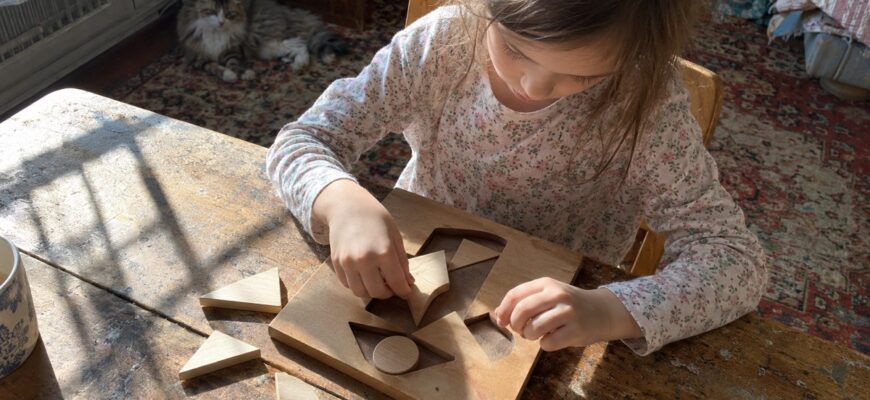
Spatial reasoning for kids can begin with ordinary actions: turning a puzzle piece, copying a block model or explaining a route to a toy. Children compare shapes and positions, notice direction and connect three-dimensional objects with flat pictures. Blocks, paper and a small clear play area are enough to get started.
Introduce one new difficulty at a time. A child who is handling unfamiliar vocabulary, a complicated diagram and many small pieces may need help with several different things. The eight activities below offer a clear starting point and an optional next step. Choose one or two rather than treating the list as a single long lesson.
- 1. Copy a small block model
- 2. Fill a silhouette with shapes
- 3. Predict a quarter turn
- 4. Follow a route on a grid
- 5. Make a tabletop plan
- 6. Describe a treasure's location
- 7. Compare different views
- 8. Build a pattern from spoken directions
- FAQ: spatial reasoning activities
- What age should we start?
- Do we need a tangram set?
- What if left and right are confusing?
- Can we begin with three-dimensional models?
- What progress should I look for?
- Should I correct every vague instruction?
1. Copy a small block model
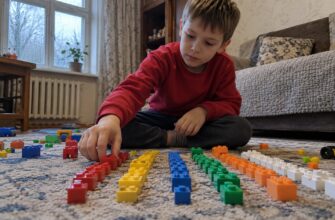
Build a model with three or four identical blocks and leave it in view. Ask your child to make a matching model beside it. Compare more than height: which blocks touch the table, which are on top and whether a block projects to one side. View both models from the same direction when checking them.
For a next step, photograph the model from the front and remove the original. Discuss a limitation of the picture: blocks can hide behind other blocks. More than one construction may match a front view. Ask for another view when needed instead of expecting a child to guess invisible details.
2. Fill a silhouette with shapes
Draw a rectangle and cut a second matching paper rectangle into two triangles. The challenge is to fill the outline using both pieces without overlaps or gaps. Let your child move the pieces freely at first. Discuss matching edges and where a triangle's point moves when the piece turns.
Increase the challenge with four large pieces or make a different outline from the same pieces. Check the complete boundary rather than accepting something that simply resembles the target. State whether turning a piece face down is allowed. That rule matters because flipping and rotating are different actions.
3. Predict a quarter turn
Draw an arrow on a square card. Turn the card a quarter turn to the right and ask where the arrow now points. After a few visible examples, invite a prediction before moving the card. Your child can check the prediction by doing the turn rather than waiting for you to announce a result.
An older child can use an L-shaped arrangement of three squares and compare several drawings. Which drawing is a rotation of the original? A mirror image may require flipping the paper rather than turning it on the table. Cut out a model and investigate when a picture is difficult to imagine.
4. Follow a route on a grid
Draw a four-by-four grid and put a counter in its bottom-left square. Agree that one step moves through a side into a neighboring square. “Two steps right, one step up” ends in the third column and the second row from the bottom. Trace each intermediate square so steps are not confused with boundary lines.
Mark one square as blocked and look for a route to a target. Trace the route with a finger before recording arrows. Compare two routes by counting their steps. Reaching the same endpoint does not automatically mean that the routes have the same length or follow all the stated rules.
5. Make a tabletop plan
Put a book, a box and a toy on a table. Look down from above and draw a simple plan: one large rectangle for the tabletop and small symbols for the objects. Explain the symbols together. Exact scale is not necessary at first; the starting challenge is to match the relative positions.
Turn the plan halfway around and try matching it to the table again. Find a reliable landmark, such as the table edge closest to a window. Rotate the paper back when needed and compare the two orientations. A room plan can follow later; see these map and route activities for kids.
6. Describe a treasure's location
One player places a large toy somewhere in a visible play area, and another finds it using a spoken instruction. Try “under the box,” “between the book and the house” or “behind the chair on the window side.” Specify the observer's position when using left and right because those words depend on orientation.
Swap roles. An adult can follow an ambiguous instruction in one reasonable way and then ask for clarification. Keep the tone collaborative: the aim is to make a description useful to another person. Add a landmark together rather than turning an unclear phrase into a trick or a reason to criticize.
7. Compare different views
Build a low block house and look at it from the front, side and above. Move your own position so each view comes from a real observation. Draw simple views or take photographs. Ask which blocks appear in two pictures and which disappear behind other parts of the model.
Begin with obvious differences between views. You can also build two different models that share a front view, then inspect their sides. This shows why a single image may not reveal everything. Avoid asking for a unique answer when the visible information genuinely allows more than one model.
8. Build a pattern from spoken directions
Use four large squares in two colors. Keep a sample hidden and describe it: “Top row: red, blue. Bottom row: blue, red.” Reveal the sample afterward and compare one position at a time. If there is a mismatch, identify a particular instruction that could have been clearer.
For related practice, explore Logic and Mathematics for ages 8–10, which includes grid routes. After a digital challenge, make a similar problem on paper. Change the objects or direction while keeping a clear checking rule so the activity calls for reasoning rather than remembering one layout.
FAQ: spatial reasoning activities
What age should we start?
Choose by the action your child can currently manage: comparing two models, following “above” and “below,” or moving a counter into a neighboring square. Suggested ages offer a starting point. Observe an attempt and adjust the number of pieces, instructions or viewpoints accordingly.
Do we need a tangram set?
No. Two paper triangles and a simple outline are enough for an initial activity. A purchased set can offer durable pieces and a selection of challenges. Check piece size and clear rules rather than choosing mainly on promises of broad developmental benefits.
What if left and right are confusing?
Use one viewing position and move alongside the toy. Begin with familiar room landmarks, then introduce directional words. Avoid changing the child's position, the paper's orientation and the vocabulary at the same time. Keeping two of those stable makes the remaining difficulty easier to discuss.
Can we begin with three-dimensional models?
Yes, using a few large pieces and a visible example. Moving from an actual model to a photograph introduces another challenge. Let your child turn the construction and compare it with the picture before asking for an imagined view of a hidden side.
What progress should I look for?
Notice specific actions: a deliberate rotation, checking a boundary, asking for a second view or clarifying the starting direction. Try a new model of similar complexity. Finishing more familiar cards may reflect practice with those cards rather than independent use of the underlying strategy.
Should I correct every vague instruction?
Choose one detail that matters for the current task. If an instruction works, let the other player follow it and discuss a clearer version afterward. Constant wording corrections can interrupt the reasoning. Checking what “behind the box” means is often enough for one turn.