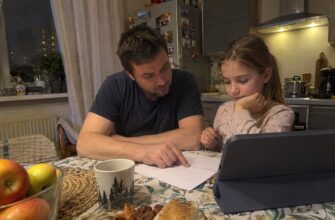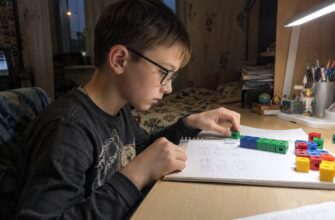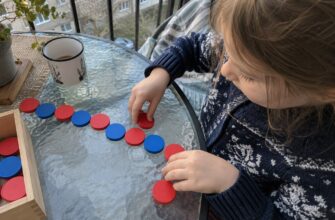
Elimination logic puzzles for kids invite children to work from explicit clues. A solver does not choose a favorite character or guess an author's hidden number. Instead, they remove options that contradict the information. When one option remains, the complete answer still needs to be checked against the whole story.
Begin with three characters and three items. Toys, cards or a small grid can make the possibilities visible. Avoid adding many negative statements, unfamiliar words and complex notation at once. Below are three worked puzzles, a separate insufficient-information example and ways to help while leaving the next reasoning step to your child.
- Explain what a clue actually says
- Puzzle 1: the three houses
- Record the result in a simple grid
- Puzzle 2: a queue
- Puzzle 3: number cards
- Notice when a unique answer is impossible
- Give help in small steps
- Create a puzzle of your own
- FAQ: elimination puzzles for children
- When do we need a grid rather than toys?
- Is trial and error allowed?
- What if a clue is forgotten?
- How can we explain “neither one nor the other”?
- How can we test a child-made puzzle for uniqueness?
- What counts as a useful session result?
Explain what a clue actually says
“The cat does not live in the red house” rules out one pairing: cat and red. It does not automatically identify the red house's resident when nothing else is known. Show the distinction with cards. Cross out only the forbidden pair and keep the other possibilities open until another reason appears.
State the one-to-one rule separately. If three characters receive three different toys, one toy cannot belong to two characters. Without that condition, repeats might be allowed. Do not insert the rule silently because it is common in this puzzle format. A solution should follow from information the child has actually been given.
Puzzle 1: the three houses
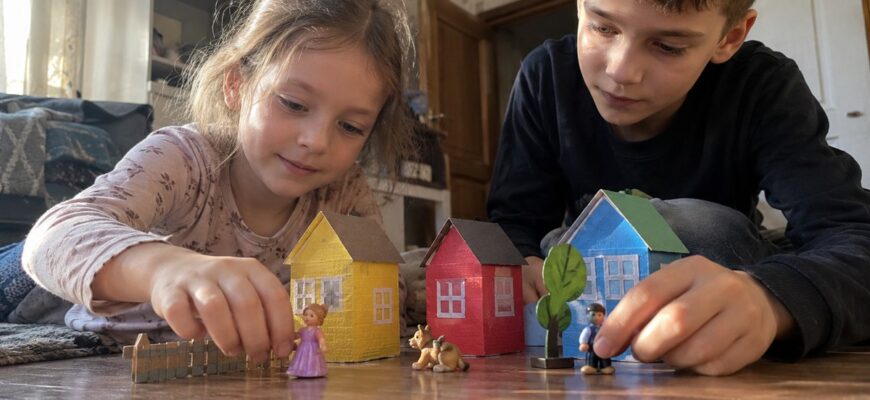
A cat, a dog and a rabbit live in three different houses: red, blue and green. Each house belongs to exactly one of these characters. The cat lives in neither red nor blue. The dog does not live in blue. Which house belongs to each character? Lay out three house cards and reread the clues together.
The cat must have green because the other two colors are excluded. Red and blue remain for the dog, but blue is forbidden, so the dog has red. Blue remains for the rabbit. Check the whole answer: houses are different, the cat has neither red nor blue and the dog does not have blue.
Record the result in a simple grid
Make three character rows and three color columns. A cross represents an impossible pairing and a circle represents a confirmed one. Once green is assigned to the cat, remove green from the other rows because the houses differ. The remaining colors are no longer possible in the cat's row either.
If symbols distract from the story, begin with movable toys and transfer the conclusions to paper afterward. Each cross should have a reason from a clue or the one-to-one rule. It should not mean “I feel like trying another color.” Ask your child to explain one particular mark rather than describe the entire grid in formal language.
Puzzle 2: a queue
Daniel, Lena, Max and Olivia stand in a queue, each in a different position. Daniel is first, Olivia is last and Lena stands immediately before Max. What is the order? Draw four spaces. Place Daniel in the first and Olivia in the fourth, leaving only the second and third positions for the remaining pair.
Because Lena is immediately before Max, Lena takes second and Max takes third. The order is Daniel, Lena, Max, Olivia. Discuss the word “immediately”: nobody stands between the pair. Try the reversed placement and identify the exact condition it breaks. Using the correct two open spaces is not enough when their order is also specified.
Puzzle 3: number cards
Nina, Paul and Roman each have a different card showing 12, 14 or 16. Nina's number is greater than fourteen. Roman's number is not twelve. What does everyone have? Only sixteen is greater than fourteen, so Nina has sixteen. Fourteen itself does not satisfy “greater than fourteen.”
Twelve and fourteen remain. Roman cannot have twelve, so he has fourteen, leaving twelve for Paul. Check all three values and both restrictions. For a follow-up, change Nina's clue to “at least fourteen.” Her value is no longer forced by that clue alone in the same way; the possible assignments must be examined again.
Notice when a unique answer is impossible
Nadia, Ian and Sophie choose different activities: drawing, modeling clay and building. The only clue is that Nadia did not choose drawing. Can every activity be identified? No. Nadia could use clay, Ian could draw and Sophie could build. Nadia could also build, Ian could use clay and Sophie could draw.
Both arrangements fit the stated information. Ask for another valid arrangement and a useful additional question. This is not a guessing game about a character's imagined preferences. Finding multiple possibilities helps distinguish a workable answer from a uniquely established answer. Add sufficient clues when your intention is to offer one definite solution.
Give help in small steps
Start by rereading one clue. Next ask which possibility it removes. Then look for a character with the fewest remaining options. Only after those prompts should you demonstrate one deduction together. Leave the following step to your child so that a helpful conversation does not quietly become an adult solving the entire puzzle aloud.
If a complete answer comes immediately, ask which clues support it and whether another arrangement could fit. A quick answer may be correct, but checking helps separate a reasoned conclusion from a lucky guess. The explanation can be a few words or a finger moving across cards; it does not need to become a long written proof.
Create a puzzle of your own
Make a completed arrangement of three characters and three objects first. Write several clues, hide the model and try reconstructing it using only the text. Add a clue if several solutions remain. If none remain, locate the contradiction. This order lets a young puzzle author test the task before presenting it to another person.
For more stories, explore Logic Investigations, which includes elimination and one-to-one assignments. For another format, try beginner sudoku: removing impossible options under clear constraints is useful there too. Keep the emphasis on a checkable reason rather than trying symbols until a board happens to look complete.
FAQ: elimination puzzles for children
When do we need a grid rather than toys?
A grid helps when keeping track of the options becomes difficult. Three-character puzzles can begin with movable cards. Introduce the written grid after the story makes sense, so that the child does not have to learn unfamiliar notation and interpret several clues at the same time.
Is trial and error allowed?
A temporary assumption can be useful if it is clearly marked and checked against every condition. Distinguish deliberate testing from guessing with no review. For beginning puzzles, first look for a direct deduction already supported by one or two clues before exploring a longer chain of possibilities.
What if a clue is forgotten?
Keep the text or a clue card visible. Read one item at a time and mark the clues already used if that helps. When the purpose is a logical conclusion, remembering the entire passage is not an additional requirement. A visible reference can support reasoning without supplying the answer.
How can we explain “neither one nor the other”?
Show two separate prohibitions with cards. “Neither red nor blue” removes both colors for the named character. Ask for the clue in the child's own words. Avoid adding complicated double negatives while straightforward forbidden pairings still require considerable effort to interpret.
How can we test a child-made puzzle for uniqueness?
List the possible assignments and retain only those satisfying every clue. Three different items have six one-to-one arrangements. More than one remaining arrangement means the clues do not determine a unique solution; no remaining arrangement means some conditions conflict. Revise one clue and test again.
What counts as a useful session result?
A child can explain one exclusion, make a following assignment and check it against the clue. Large grids are not necessary. A fresh small story gives a clearer opportunity to see independent use of the method than repeating a familiar completed arrangement from memory.