Number patterns for kids offer a chance to notice a relationship, explain it and check it on new examples. A pattern might begin as alternating colors, move to growing groups and later connect an input number with an output. Naming the next answer is only part of the task; the reasoning matters too.
Large counters, blocks and paper are enough for a home activity. Begin with short rows and keep the example visible. Asking a child to remember a long sequence can mix a memory challenge with the pattern itself. The activities below introduce several kinds of rule and show how to check each one.
- Find the repeating unit
- Change the objects but keep the structure
- Compare growing patterns
- Give a clear rule for number sequences
- A short sequence can allow several continuations
- Play with a rule machine
- Find and repair an error
- FAQ: patterns and sequences for children
- Where should a younger child begin?
- What if the answer is correct but unexplained?
- Must we always choose the simplest rule?
- How can we make a task harder without larger numbers?
- Can color, shape and size change together?
- How can I notice independent use of a rule?
Find the repeating unit
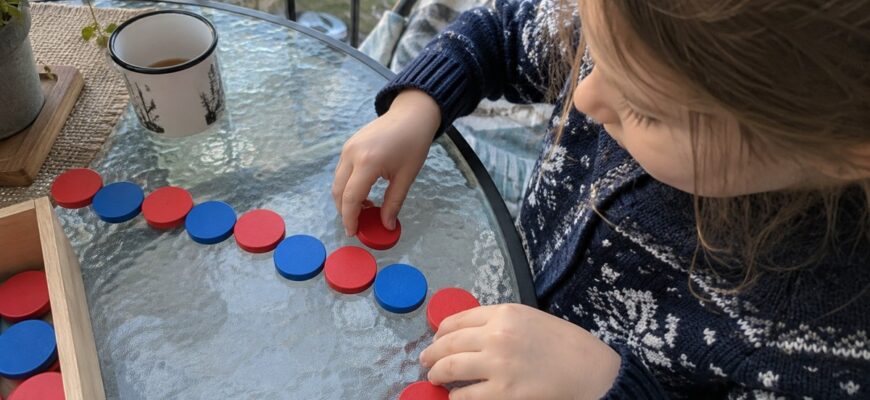
Arrange red, blue, red, blue, red, blue. Ask which small group repeats. Here it is the pair “red, blue.” Put a frame around each pair or leave small gaps between units. Red comes next, but invite four more counters and a reason instead of stopping after one possibly lucky response.
Next use a group of three: circle, circle, square; circle, circle, square. After the next circle, another circle comes before the square. A child accustomed only to alternating pairs may choose the square too early. Return to the full repeating unit rather than describing every repeating pattern as “every other one.”
Change the objects but keep the structure
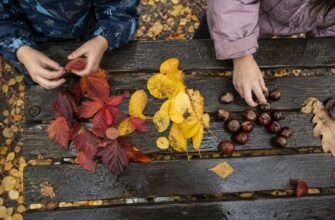
Transfer a two-same-one-different pattern into movement: clap, clap, step. Then make it with two matching blocks and one different piece. Discuss what changed in appearance and what remained alike. The child can identify the relationship among positions rather than depend on a particular combination of colors.
Compare red–red–blue with circle–circle–square. Are they organized alike? Yes, if the feature being compared is the sequence of two element types. If the stated rule specifically concerns color, the shape sequence does not answer that same question. Explain which feature matters so that adult and child are solving the same problem.
Compare growing patterns
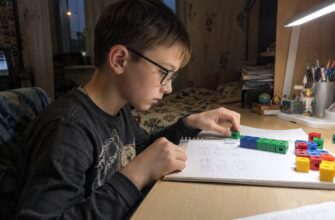
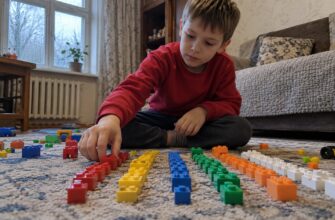
Build towers of one, two, three and four blocks. Each new tower adds one block, so the next height is five. Ask your child to show the change between neighboring towers, not just produce a final construction. This makes the growth rule something they can point to and demonstrate.
Try rows of two, four, six and eight counters. Adding two each time gives ten and then twelve. Compare this with 2, 4, 8, 16, where each number is doubled. Sharing the first two terms does not establish the same rule. Examine more than one transition before deciding how a sequence works.
Give a clear rule for number sequences
State the condition first: “Start at two and add three each time.” The sequence is 2, 5, 8, 11, 14. Then leave a gap: 2, 5, blank, 11, 14. Eight fits, and it can be checked in both directions: 5 + 3 = 8 and 8 + 3 = 11.
For a decreasing sequence, start at twelve and subtract two: 12, 10, 8, 6, 4, 2, 0. If negative numbers are unfamiliar, agree beforehand to stop at zero. That boundary is part of the exercise. A child asking what happens next is raising a reasonable question about the rule's range rather than making a mistake.
A short sequence can allow several continuations
Without another condition, 1, 2, 3 does not force a unique next number. One rule adds one each time; another repeats the unit 1, 2, 3. School tasks often intend a familiar simple rule, but it helps to distinguish a rule that fits the examples from a rule explicitly required by the question.
There is no need to invent elaborate formulas. Ask your child to name a chosen rule and check all the displayed steps. If you want one particular answer, specify the constraint: “Add the same amount each time.” Clear conditions prevent a reasonable alternative from being declared wrong simply because it differs from an unstated expectation.
Play with a rule machine
Draw a box with an entrance and exit. Agree that the machine adds four. One enters and five comes out; three enters and seven comes out. What happens to six? The output is ten. Reverse the question: if nine comes out, which number entered? Five, because 5 + 4 = 9.
After several open-rule rounds, hide the rule and offer examples plus a short list of possible rules. Suppose 2 becomes 4, 5 becomes 10 and 7 becomes 14. Of “add two,” “double” and “add five,” doubling matches all three pairs. A rule must fit every given pair, not merely one successful example.
Find and repair an error
Show a row that is supposed to increase by three: 3, 6, 9, 13, 15. The first broken transition occurs between nine and thirteen. Replace thirteen with twelve and check both neighboring steps: 9 + 3 = 12 and 12 + 3 = 15. State the intended rule before asking for the incorrect term.
Let your child create an error puzzle for you. Write the intended rule separately and reveal it after your attempt. If several terms need repair, look together for where the structure changed. Discussing the design of a puzzle can preserve the child's interest while still making the answer clear and checkable.
For related practice, explore Logic and Mathematics, which includes numerical conditions, or return to logic games with everyday objects. Keep the purpose concrete: notice a relationship, describe it and test it on a new example. A short successful check is more informative than a long list of guesses.
FAQ: patterns and sequences for children
Where should a younger child begin?
Begin with a repeating pair of large objects and let the child extend it by moving pieces. Keep the sample visible. Add a three-part unit or change the materials once the complete unit is recognizable. Numbers are not required for an initial activity involving repetition.
What if the answer is correct but unexplained?
Ask your child to point to the repeating unit or compare two neighboring steps. Extending the row by several more elements can also reveal the method. A demonstration, sketch or short phrase can explain a rule without requiring a formal definition or lengthy spoken response.
Must we always choose the simplest rule?
A classroom exercise usually asks for a manageable rule within stated constraints. A short sequence with no additional condition can still allow alternatives. Ask for a rule that fits and a check of the examples. Specify the boundaries explicitly when a unique answer is needed.
How can we make a task harder without larger numbers?
Leave an internal gap, transfer the rule to a different material or ask for an error to be located. Keep small numbers while asking for the reverse operation in a rule machine. A reasoning challenge can become richer without increasing the size of every calculation.
Can color, shape and size change together?
Yes, after simpler rules are clear. Agree which features change and which stay constant. If every feature changes with no explicit relationship, several different patterns may be possible. A clear checking condition is more helpful than adding complexity that neither player can reliably evaluate.
How can I notice independent use of a rule?
Try a new starting number under the same condition or unfamiliar objects arranged in the same structure. Invite a child-made example and a check of someone else's. Transferring the method and spotting a violation provide more specific information than recognizing a familiar completed row.