Memory games for kids can fit naturally into family play. Children remember cards, story events, instructions and the steps of a solution. A useful session introduces ways to organize that information, rather than testing how many disconnected items they can repeat.
Try pictures, grouping, a short story or a spoken rehearsal. Ask which method your child used. A strategy that helps with one task may need adjusting for another, so avoid assigning a permanent label such as “a visual learner.”
- Identify what the task requires
- Six activities with practical variations
- 1. Matching pairs
- 2. Pack a pretend suitcase
- 3. Find the missing object
- 4. Draw a story map
- 5. Repeat a room route
- 6. Return after a break
- Organize information before memorizing
- A flexible weekly routine
- Respond to a difficult attempt
- Use the methods in real learning
- Add a digital option
- FAQ: children's memory games
- How many words should a child remember at a certain age?
- Should a retelling be word for word?
- Are pictures better than words?
- Can we repeat the same game?
- Why was yesterday's result better?
- Will memory games improve grades?
Identify what the task requires
Remembering a shopping list is different from recalling a story's meaning or holding several instructions in mind. Sometimes a child seems to have forgotten information that they never understood or heard clearly. Check the vocabulary and instruction before adding more practice.
Separate the result from the method. A child who remembers three items after grouping them has shown a useful approach, even if the fourth is missing. Discuss what the grouping captured and what needs another reminder.
Six activities with practical variations
1. Matching pairs
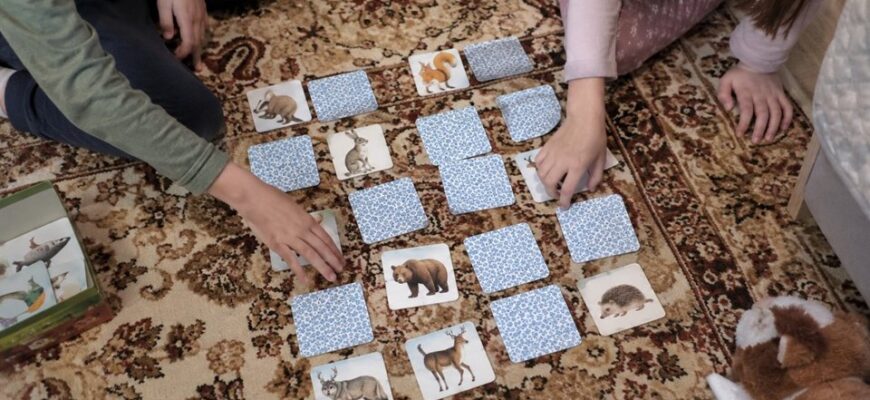
Begin with four pairs of identical pictures. Place them face down. Players turn over two cards on each move, keep matching pairs and return nonmatching cards to their positions. Encourage the child to notice locations such as a corner or the top row.
Increase the challenge by adding one pair or changing the arrangement. Avoid introducing a large grid immediately. If competition creates tension, work together to find the pairs instead of comparing who collected the most.
2. Pack a pretend suitcase
The first player says, “I am taking a flashlight.” The next repeats that item and adds a water bottle. Continue with a few familiar objects for a camping trip, beach visit or sleepover.
Invite the child to imagine where the objects sit in a suitcase. Alternatively, connect them through a silly story: the flashlight shines on the bottle beside a map. Ask how that image helps recover the list instead of treating it as a magic trick.
3. Find the missing object
Arrange a small group of familiar items. After your child has looked, cover them and remove one. Uncover the collection and ask what is missing. Discuss whether the child remembered names, groups or positions.
Switch roles after a few rounds. Preparing the collection gives the child a different perspective on the same rule. Adjust the number of items separately from how similar they look.
4. Draw a story map
Tell a brief invented story: a child finds a key, meets a cat and opens a garden gate. Draw three simple symbols, then retell the events using the pictures. The aim is the sequence and connections, rather than the original wording.
Ask what belongs in the middle if one drawing is covered. Later, invite the child to invent a new story with a similar number of events and explain it to another family member.
5. Repeat a room route
Move a toy to a chair, a table and a shelf. Your child repeats the route. Start with two safe, accessible stops and add another when the sequence is comfortable. Do not choose places that require climbing.
The child can then create a route for you. If a step is missed, retrace the known part and identify the next location. A small sketch can provide support before attempting the route without it.
6. Return after a break
Discuss three new pictures or familiar words. Ask the child to recall them, then revisit them after a different activity. If something is missing, show the material again and discuss a useful cue.
This gives an opportunity to retrieve information rather than repeat it continuously. Keep the exercise low pressure. A delayed attempt is another chance to understand the method, not a verdict on memory ability.
Organize information before memorizing
A list such as apple, bus, pear and train becomes easier to discuss as two groups: fruit and transport. If an item is missing, naming the category may be enough to help. Avoid supplying every answer immediately when a broader cue would work.
For a sequence, try a story. For locations, try a simple map. For a text, ask who was involved, what happened and how it ended. These are options to test on manageable material, not a compulsory universal system.
A flexible weekly routine
Play pairs on one day, pack a pretend suitcase on another and use a story map later in the week. Return to a familiar collection after a pause. At the weekend, invite the child to organize a game for the family.
The schedule can change. A brief conversation about what to take on a walk also provides a remembering task. Consistency should support a pleasant routine rather than create constant measurement or a new family obligation.
Respond to a difficult attempt
Reduce the number of items, remove unfamiliar words and allow enough viewing time. Ask the child to repeat the instruction and choose a cue. If necessary, demonstrate with two objects before offering another attempt.
Replace “You forgot everything again” with a specific observation: “You remembered three things. Let's find a way to keep track of the fourth.” One game cannot establish how a child's memory functions across all situations.
Use the methods in real learning
Before learning a short poem, discuss its meaning and divide it into understandable parts. For a school rule, ask for an example. For a multistep instruction, make a brief checklist and mark completed actions.
External reminders can help organize information. They do not make the activity pointless. Later, notice which steps the child performs without the list, and reduce support where it is no longer needed.
Add a digital option
Explore memory games on IQClass, choose one exercise and discuss the method after a round. Its score describes performance in that task, rather than general intelligence or school potential.
Alternate cards, stories and digital challenges. If details are missed before they can be remembered, also try attention activities. It is useful to distinguish noticing information from recalling it later.
FAQ: children's memory games
How many words should a child remember at a certain age?
A homemade game does not establish a universal norm. Familiarity, conditions and presentation affect the result. Select a manageable number and observe how the child uses a strategy instead of comparing them with an unsourced online chart.
Should a retelling be word for word?
For discussing a story, preserving the meaning and main sequence is usually the relevant aim. Exact repetition is a separate task. Explain which outcome you want before asking the child to remember.
Are pictures better than words?
Both can be useful. Pictures help when reading adds an obstacle, while familiar words suit a spoken story. Choose the format for the task rather than assuming one permanent learning type.
Can we repeat the same game?
Yes, if the child enjoys it. Change the pictures, theme or positions so the method is used with fresh material. Let the child prepare a round once the rules are familiar.
Why was yesterday's result better?
Fatigue, interest, instructions and difficulty can change. Compare similar activities under similar conditions. One disappointing attempt does not describe memory overall.
Will memory games improve grades?
That cannot be guaranteed. They provide practice in remembering and choosing cues. Schoolwork also requires understanding the material and applying the approach to its specific demands.