
Why is the course useful?
We will open up a lot of interesting techniques and methods for the child to become better in all areas of activity.
Make instant decisions
Learn to quickly and objectively assess the situation

Increase productivity
Use your time more efficiently

Switch between tasks easily
Learn to work in multitasking mode
Think rationally
Make balanced and rational decisions

Find optimal solutions
Learn to predict the consequences of your actions
Speed up your Mental Maths
Easily perform complex mental arithmetics
Take advantage of the brain’s capabilities to the max

Why is it useful for children to develop reasoning?
Training of thinking is necessary for full and harmonious development of the child. The inability to absorb new information has a negative impact on educational success, communication in society, thinking and individual abilities.
The course for thinking development from IQClass is a great incentive to spend time with children, combining the pleasant with the useful. You will notice how much easier and easier the child will be given new information, because the course not only trains non-standard thinking, but also further develops: memory, attention and creativity.
The course consists of 10 games
Olympic
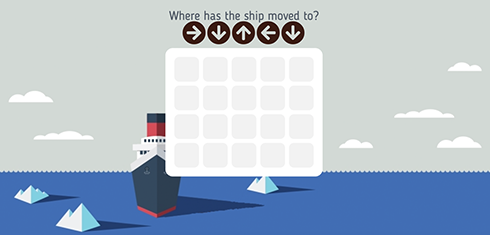
At the beginning of the game you will see a field consisting of cells. Then the ship will appear in an arbitrary place. After a couple of seconds the ship will disappear from view, and at the top of the screen its path will appear in the form of arrows. To complete the level, you must specify the point at which the ship will arrive after all the movements.
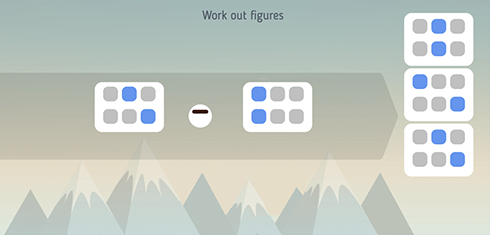
Merging shapes
The shapes will appear on the screen, which, depending on the task, a user needs to add or subtract. The child needs to imagine that one shape is superimposed on the other, and then to think about the future appearance of the resulting shape and choose the right answer from the suggested.
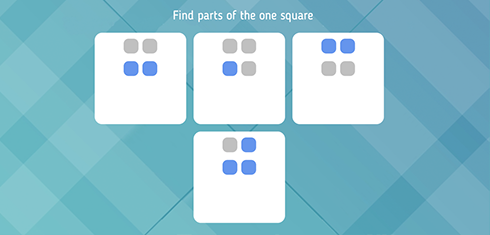
Make a square
A few shapes will appear on the field. To complete the round, a user has to choose a pair, at the confluence of which a square is formed.
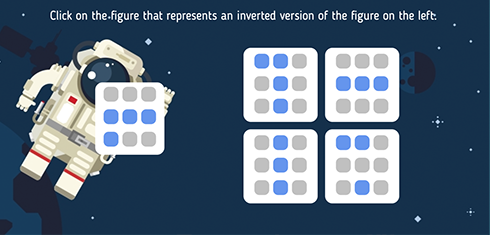
Rotation
The shape and several answer options on the right will appear on the screen. To win the game, a user has to select a shape which represents a turned-over initial shape.
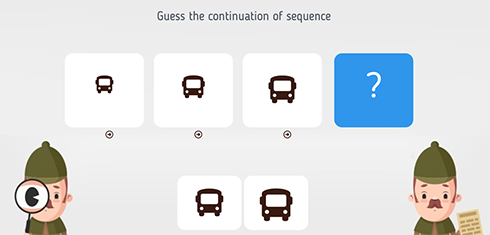
Deduction
At the top of the playing field there is a sequence of cards with pictures. To win, a user has to select the card from the bottom row, which logically continues the offered sequence.

And other games
Before the beginning of classes your child will have to pass a special test, which will show how well the skill of reasoning is developed. Next, we will create an individual training program within the course. After a month of training the system will display the statistics with the results.
Start trainingReasoning Development Program
Do you want to develop your child’s thinking, but you are catastrophically short of time? Then our course is for you.
7 lessons
Interesting theory
10 games
Unique author’s developments
Introductory and final tests
To assess current level and results
Adaptive Program
Daily workout will adapt to your progress

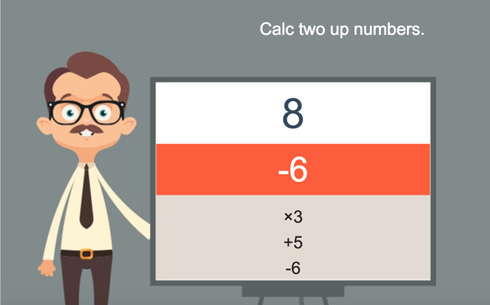



Logic exercises for children with comparison, patterns and rule checking. Try a task with an explanation and read FAQs about practice.
Start trainingFinding a rule and explaining an answer
In reasoning exercises, children compare features, notice an order and test an idea. The aim is more than choosing an option: explain a rule that fits all the supplied conditions.
Consider several options and work out why one fits better. Pictures, numbers and game fields offer different materials for practising a consistent line of reasoning.
Parent questions that support reasoning
Instead of supplying the answer, ask: what repeats, which detail changed, does the rule fit the beginning of the sequence? Let your child test and revise their own idea.
If several solutions seem possible, return to the instructions and clarify the constraints. The example below specifies the rule precisely. Explaining a choice is more useful than guessing the right button.
Check a pattern
Each number in the sequence is 3 greater than the previous one: 2, 5, 8, 11, …
Which number comes next?
Answer and explanation
Add 3 to the last number: 11 + 3 = 14. The rule fits the whole sequence.
This is a separate page example, with no timer, registration or saved profile result. Course games have their own rules.
Frequently asked questions: Reasoning practice
Which skills do logic games use?
Comparison, feature selection, pattern recognition and checking conditions. Specific rules depend on the game and are explained before play.
What if my child guesses?
Ask your child to explain one feature or test the chosen rule on another element. Begin with a simple example and allow time for an answer.
Are course results an IQ assessment?
A game score reflects performance on a particular exercise. It does not replace a standardised test or provide an overall assessment of a child’s intelligence.
How do we start?
Read the description and try the example below. The start button takes you to registration or course activation in your account. Access conditions are shown before starting the course.
How long should a practice session last?
Begin with one short exercise and watch how your child feels. Leave time to discuss the rule and a mistake. Manageable regular practice is more useful than rushing; there is no mandatory session length for every child.
Does a child need an adult’s help?
At first, read the instructions together and ask your child to explain the rule in their own words. Help with the controls while letting the child choose the answer. Take a break if the exercises become tiring.