
Why is the course useful?
Memory is needed to solve almost any problem
Memorize more details
Will be as attentive as Sherlock Holmes
Remember parents’ phone numbers
So the child can always contact you
Easier to learn languages
You can memorize new words and the most complex rules faster
To study more efficiently
Capture new information instantly
Better navigate in unfamiliar places
Did you ever get lost at the mall?
High orderliness
The handicraft you made for school will not be forgotten on the table
Take advantage of the brain’s capabilities to the max

What do children need a good memory for?
The most frequent complaint of people in everyday life is a bad memory, and it doesn’t matter if it’s the name of the first teacher or where the keys to the apartment are.
Memory training is necessary for the child’s full and harmonious development. The inability to absorb new information has a negative impact on educational success, communication in society, thinking and individual abilities. Interactive training programs will help children quickly remember large amounts of information.
How does it work?
Memory exercises for children with images, positions and sequences. Explore an unhurried routine, try a short example and read answers for parents.

Authors’ algorithm will select interesting and useful tasks for effective memory development. Children can find their own approach: group details, say a sequence aloud or connect objects with a familiar story. Discuss which approach helped instead of considering only the final score.

7 unique simulator games for better memory and an adaptive learning program. Solid scientific basis. Beautiful, interesting and very useful.
After a short exercise, ask your child to recall the steps in a recipe or a few things needed for a walk. Avoid turning every conversation into a test: leave room for curiosity and mistakes.
We tried to make your training interesting, and the advanced system of statistics will allow to control the regularity of training and progress. You can also compare your results with other users.
The course consists of 7 games
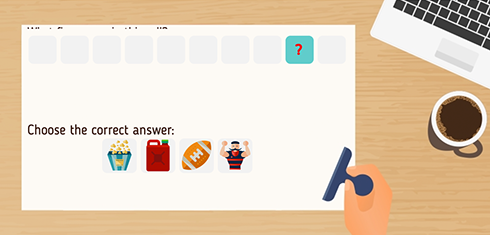
Recalling
The playing field is filled with objects. A child remembers their location and then field is hidden from view. Then the system offers options, and a player needs to choose the correct answer. If the child has lost the round, they will have to repeat it again with simplified tasks. Win after win, the game will become more difficult and more interesting.
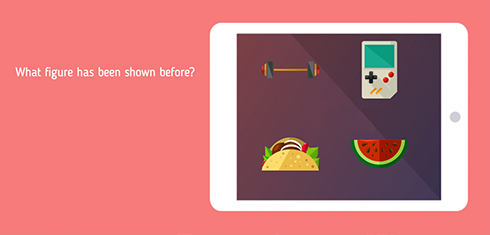
Dictation with shapes
The system shows figures to memorize one by one. When the last object disappears, the child needs to choose the one that was shown earlier.
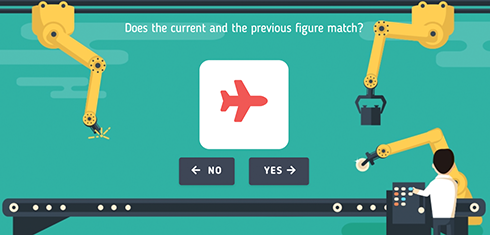
Speed comparison with rotation
A child remembers the card with the picture. The object disappears, and another one appears in its place. The child has to compare the new card with the previous one.
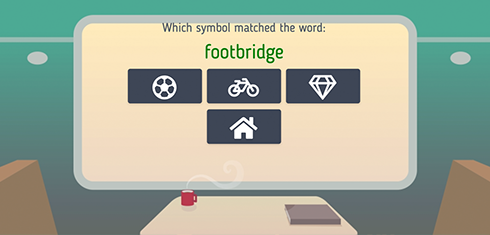
Shapes and words
The child sees pairs of shapes and words and remembers them. Then the system checks how well it was memorized.

And other games
Before the beginning of classes your child will have to pass a special test, which will show how well the memory skill is developed. Next, we will create an individual training program within the course. After a month of training the system will display the statistics with the results.
Start trainingMemory Development Program for Children
You want to develop a child’s memory, but you’re catastrophically short of time? Then our course is for you.
7 lessons
Interesting theory
7 games
Unique author’s developments
Introductory and final tests
To assess current level and results
Adaptive Program
Daily workout will adapt to your progress





What children do in memory exercises
Memory tasks ask a child to notice information, retain it and recall it: recognise a picture, restore an order or remember a position. First understand exactly what the game asks the child to remember.
Children can find their own approach: group details, say a sequence aloud or connect objects with a familiar story. Discuss which approach helped instead of considering only the final score.
Connecting memory games with everyday life
After a short exercise, ask your child to recall the steps in a recipe or a few things needed for a walk. Avoid turning every conversation into a test: leave room for curiosity and mistakes.
Remembering images and remembering words are different tasks. Vary the material and revisit a difficult example later. If your child is tired or distracted, a break may help more than repeated attempts.
Find a way to remember an order
Imagine three stops on a walk: home → park → library. Say the route aloud and invent a short story that connects these places.
Which place is between home and the library?
Answer and explanation
The park comes second in the chain: home → park → library. A connected story can help retain the order.
This is a separate page example, with no timer, registration or saved profile result. Course games have their own rules.
Frequently asked questions: Memory practice
What kinds of memory tasks are there?
Tasks may involve remembering images, positions, pairs and element order. Each game has its own rules: read the instructions before the first round.
What if my child makes frequent mistakes?
Discuss fewer details at a time, review the rule and try naming a memory strategy. A mistake in one game is not an assessment of all your child’s abilities.
Do children always need to remember faster?
Accuracy and a clear strategy come first. Discuss speed later if the particular game uses it. This page example has no time limit.
How do we start?
Read the description and try the example below. The start button takes you to registration or course activation in your account. Access conditions are shown before starting the course.
How long should a practice session last?
Begin with one short exercise and watch how your child feels. Leave time to discuss the rule and a mistake. Manageable regular practice is more useful than rushing; there is no mandatory session length for every child.
Does a child need an adult’s help?
At first, read the instructions together and ask your child to explain the rule in their own words. Help with the controls while letting the child choose the answer. Take a break if the exercises become tiring.