
Why is the course useful?
After taking an English course from IQClass, your child will get basic knowledge for free communication in many countries of the world.

Learning the most used words
Understanding the keywords of the dialogue

Maximum saving of time and effort
Only 850 of the most important English words

Basis for further study of English
Basic foreign language skills

Free communication while traveling
Ability to ask and answer questions correctly

Improving listening comprehension skills
Making sentences to express thoughts

The system to achieve an effective result
Expanding borders and self-improvement
A valuable baggage of knowledge that will come in handy anywhere. Take the first step to integrating into today’s world

Basic English Feature
The history of English as an international language explains the existence of many of its dialects. Even on the territory of Great Britain there are at least 5 big groups of different kinds of speech. That’s why English-speakers from different countries often feel some discomfort when communicating. Back in the first half of the 20th century, linguist Charles Kay Ogden suggested using Basic English - simplified English - for representatives of other linguistic communities.
Basic English course from IQClass consists of 850 of the most used words in everyday life. Knowing them, as well as the basic grammar rules, a child acquires skills for simple dialogues. This requires a minimum of effort. This method of learning allows children to express their thoughts while traveling, and also provides a foundation for those who plan to learn English.
Basic English course for children allows to overcome the material in a short time
This study system is built on a logical chain:
- Memorizing words.
- Plural formation and memorization of the exceptions.
- Articles and verbs usage rules.
- Studying 100 action words.
- Quality and degree expression rules.
- Build questions and answers.
- Past, future and present.
- Strengthening of knowledge.

The course consists of 6 games
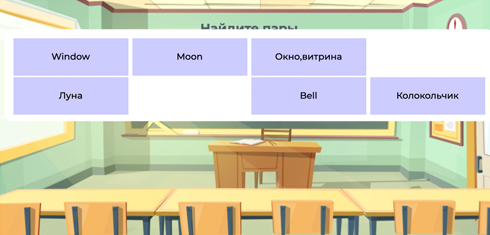
Memory
Find all the word-translation pairs on the game board.
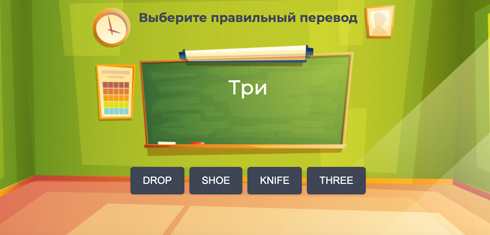
Translation-Word
Quickly select the translation for the target word.
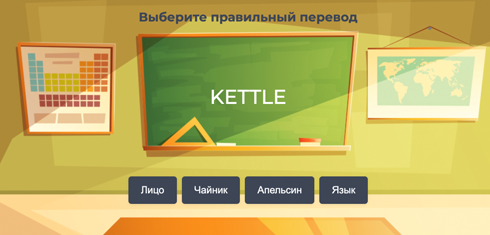
Word-Translation
Quickly select the translation for the target word.
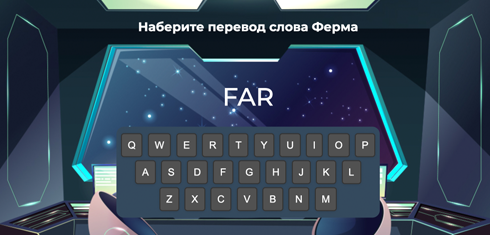
Letter-by-letter typing
Type the translation of the target word.
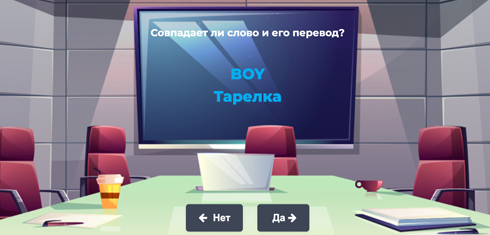
True-False
Quickly answer whether the Word and its Translation match.
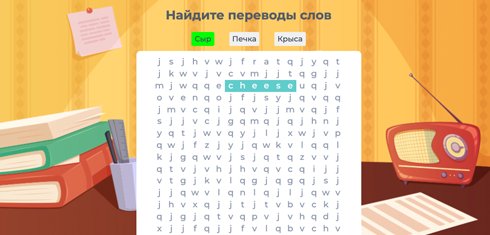
Find the translation
Find the translation of the word among the English letters.

And other games
Before the beginning of classes your child will have to pass a special test, which will show how well the English words vocabulary is developed. Next, we will create an individual training program within the course. After a month of training the system will display the statistics with the results.
Start trainingCourse structure:
You get not just a theory, but a complex system of learning English.
7 lessons
The combination of simple theory and entertaining practical tasks.
6 games
Designed specifically for BASIC English course
Cards
Convenient word memorization mechanism
Personal learning program
Create your own training dictionaries within the course





Learning a word together with its meaning
Learning an English word starts with connecting its spelling and meaning. Compare words, say them aloud and think of an example your child understands. Reviewing familiar material helps check what can be recalled independently.
Avoid learning a long list in one sitting. Choose a few manageable words and revisit them on different days. Recognising a word and using it freely in speech require different kinds of practice.
Supporting English practice at home
Ask your child to find a familiar word in a short sentence or name an object nearby. Connect review with interests such as animals, objects at home or school topics.
If your child recognises a word but cannot recall it without options, practise recall specifically. This course is one part of language practice; conversation, listening and reading complement vocabulary exercises.
Connect a word with its meaning
Compare three English words: cat, table, book. One of them names an animal.
Which word names an animal?
Answer and explanation
Cat names an animal. A table is a piece of furniture and a book is something to read.
This is a separate page example, with no timer, registration or saved profile result. Course games have their own rules.
Frequently asked questions: English language
Is prior English knowledge required?
Begin with words your child knows and short instructions. An adult can help with meaning and pronunciation. Choose material according to current knowledge rather than age alone.
How can we practise more than word recognition?
Try to recall the word without a clue, then check. Name an object or make a simple sentence. Multiple-choice recognition and independent recall are different exercises.
Does the course replace conversation practice?
No. Complement vocabulary exercises with reading, listening and conversation at a manageable level. The right format depends on your child’s learning goal.
How do we start?
Read the description and try the example below. The start button takes you to registration or course activation in your account. Access conditions are shown before starting the course.
How long should a practice session last?
Begin with one short exercise and watch how your child feels. Leave time to discuss the rule and a mistake. Manageable regular practice is more useful than rushing; there is no mandatory session length for every child.
Does a child need an adult’s help?
At first, read the instructions together and ask your child to explain the rule in their own words. Help with the controls while letting the child choose the answer. Take a break if the exercises become tiring.