

All courses archer

Attention practice for children: search, comparison and exercises

We have collected the best techniques, useful methods and exercises for rapid attention development. By practicing a few minutes a day, your child will be able to develop the ability to concentrate on tasks and effectively receive information from the world around.
Start training

The child will learn:

  • Concentrate Concentrate
  • Switch between tasks easily Switch between tasks easily
  • Increase the amount of attentionr Increase the amount of attention
  • Conquer distraction Conquer distraction
  • Get any job done Get any job done
Give your child the confidence and passion to explore anything on their own fearlessly.

teacher

Give your child the confidence and passion to explore anything on their own fearlessly.

Attention Development Program
illstr
7 lessons
Interesting theory
10 games
Unique author’s developments
Introductory and final tests
To evaluate current level and results
Adaptive Program
Daily workout will adapt to your kid progress
Start training
archer
Practice your attention with IQClass
Unlocking children’s potential
Start training

Attention means working with a specific rule

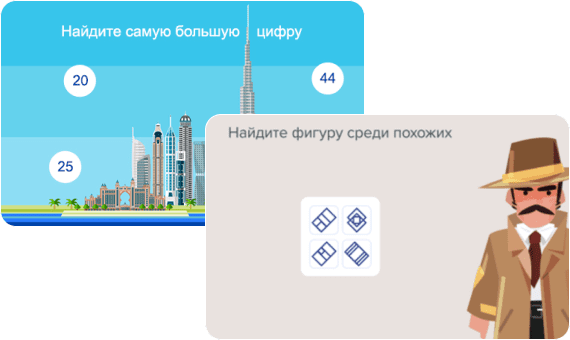
One exercise asks a child to find an object; another asks them to compare similar images or notice a change. The child selects a relevant feature and checks the answer against the rule.

Before starting, ask your child to point to one object that fits the rule. This helps distinguish an unclear instruction from an inattentive answer. Then allow time to inspect the field independently.

Practising observation without overload

Begin in a calm setting with one rule. After an answer, ask which feature helped with the choice. There is no need to increase speed, object count and rule complexity at the same time.

Game results also depend on familiarity with the controls. Do not draw medical conclusions from one round: the course offers practice rather than diagnosis. Stop when tired and return to the exercise later.

Try a short example

Notice the relevant feature

Look at the row: ▲ ● ▲ ■ ● ▲. Count only the triangles and ignore circles and squares.

How many triangles are in the row?

Answer and explanation

Triangles occupy the first, third and sixth positions. There are three in total.

This is a separate page example, with no timer, registration or saved profile result. Course games have their own rules.

Frequently asked questions: Attention practice

What do detail-search tasks practise?

They offer practice in selecting a relevant feature and comparing objects with a rule. Clarify what to look for, then inspect the field systematically.

Is a timer always necessary?

A full game may have a time limit. To learn a rule, use the untimed example below and discuss the search strategy.

Can a game identify attention disorders?

No. An exercise result is not a medical diagnosis. Instructions, tiredness, game experience and other circumstances affect it.

How do we start?

Read the description and try the example below. The start button takes you to registration or course activation in your account. Access conditions are shown before starting the course.

How long should a practice session last?

Begin with one short exercise and watch how your child feels. Leave time to discuss the rule and a mistake. Manageable regular practice is more useful than rushing; there is no mandatory session length for every child.

Does a child need an adult’s help?

At first, read the instructions together and ask your child to explain the rule in their own words. Help with the controls while letting the child choose the answer. Take a break if the exercises become tiring.